
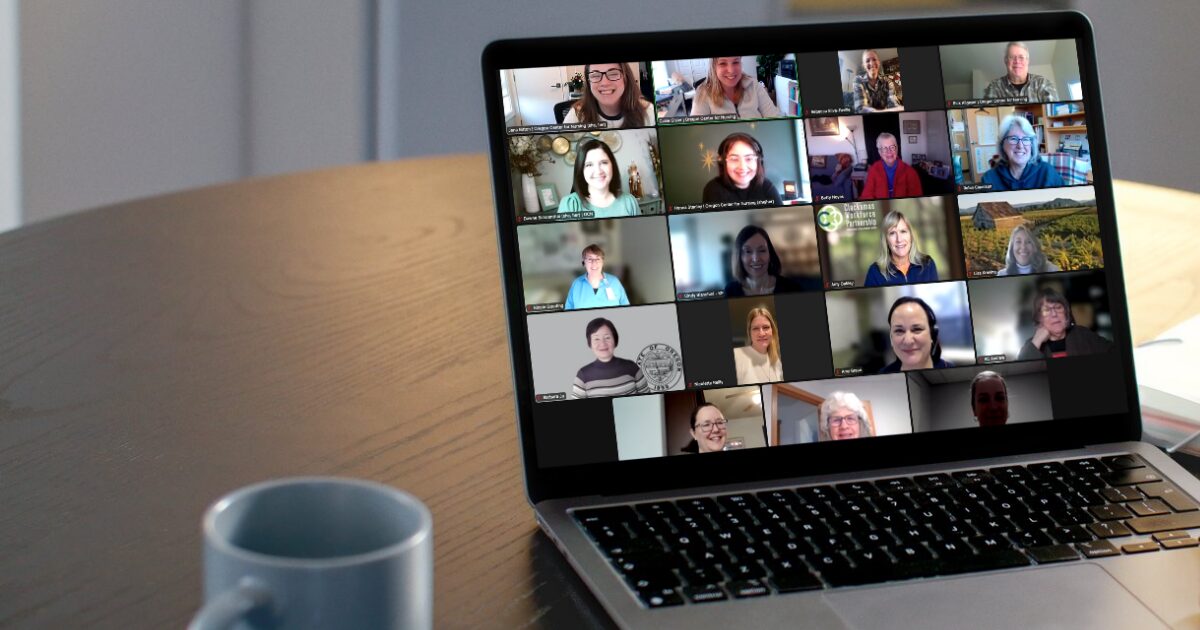
Before turning to the opportunities, workforce shifts, and policy developments ahead in 2026, we are taking a moment to look back at the conversations that shaped last year.
Each Friday morning throughout 2025, people across Oregon’s nursing landscape came together through the Friday Huddle, OCN’s weekly virtual forum. Some joined on camera, others listened in while juggling full schedules, but all participated in a consistent, statewide space for connection. What began as a simple check-in has become the only regular forum where workforce leaders, educators, and stakeholders across Oregon gather to compare notes, ask questions, and stay anchored in real-time workforce realities.
Over the course of the year, OCN hosted 45 Friday Huddles and surfaced more than 360 distinct topics. The conversations were candid, practical, and shaped by the realities people were facing in their own settings. With 2025 now complete, we are sharing what emerged from those discussions and how these insights can inform workforce planning in the year ahead.
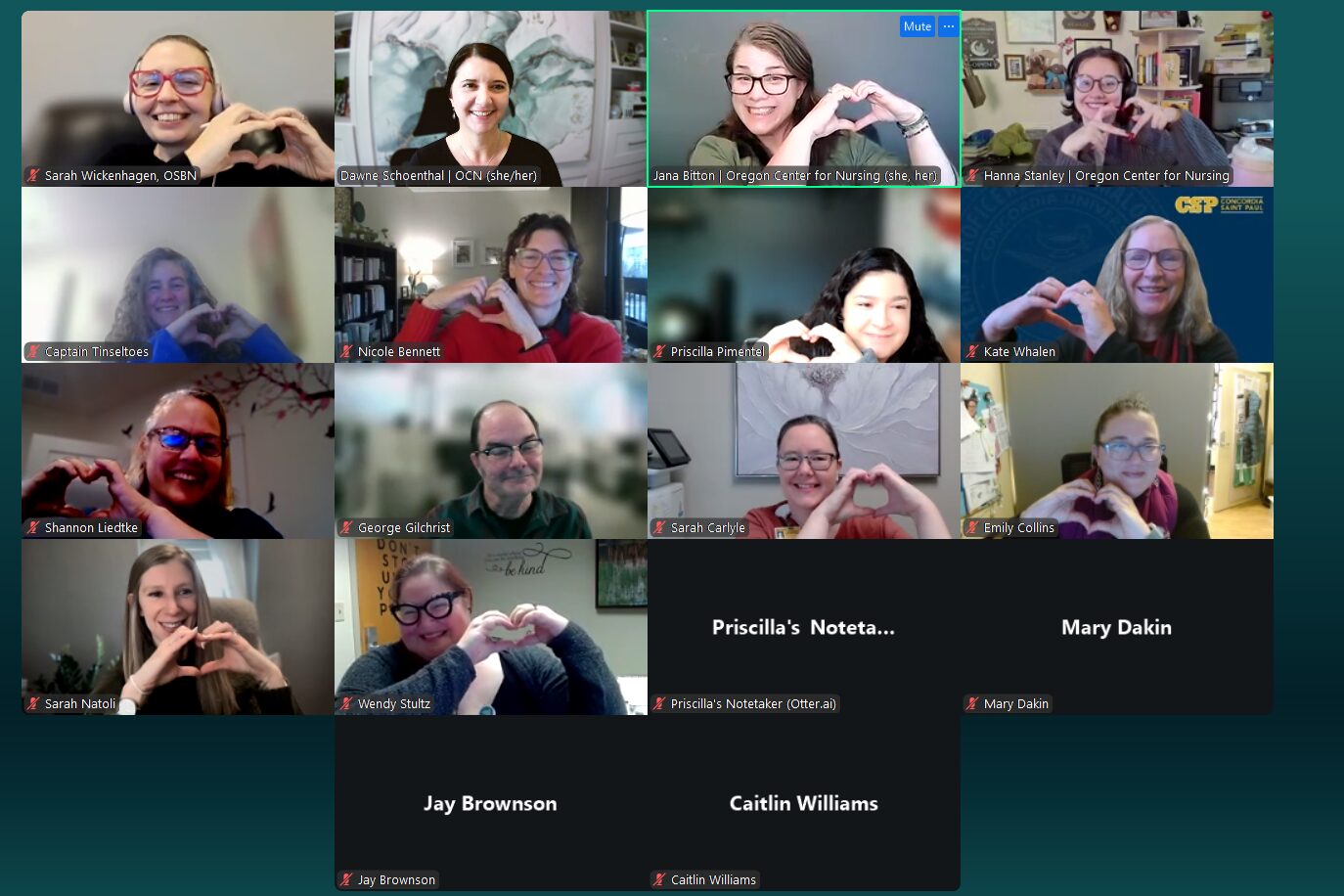
What Is the Friday Huddle?
Held every Friday at 8:00 a.m. PT via Zoom, the Friday Huddle is a free, open-access conversation space hosted by OCN. It is not a presentation or panel. It is a live, flexible forum where participants share what is happening in their part of the nursing workforce system and hear what is unfolding across others.
Each Huddle begins with a brief roundup of emerging opportunities, including grants, events, nominations, and learning sessions, along with relevant OCN updates. From there, the conversation unfolds based on the interests and needs of those in the virtual room. Some huddles stay tightly focused. Others range more widely. What they share is that they are shaped by participant input and often lead to practical insight or unexpected connections.
There is no other regular statewide space in Oregon that serves this purpose. We are grateful to the hundreds of participants who continue to show up and contribute to the quality and relevance of the conversation
“The Friday Huddle is a great way to stay connected on current issues, no matter the role you play in the healthcare field.”
Huddle Participant, 2025
The Five Most Talked-About Topics of 2025
Across hundreds of conversations, five themes rose to the top. They stood out not only for how often they surfaced, but for how clearly they reflected what was shifting across the system.
Workforce
Workforce issues surfaced more frequently than any other topic in 2025. Participants brought forward real-time challenges such as retention pressures in rural communities, licensure surges during labor actions, and emerging data on nurse manager stress and burnout. Others shared what was working, including flexible role design, nurse-led care models, and data-informed strategies aimed at improving workforce stability.
Across the year, it became clear that Oregon’s nursing workforce is in a period of active redesign. The Friday Huddle offered a steady, front-row view of that evolution as it played out in real time.
Policy
Policy discussions were a steady thread throughout 2025, reflecting how quickly shifts at the state and federal level were translating into real questions for the nursing workforce. As those changes accelerated, the Huddle became an important space to slow things down, ask clarifying questions, and talk through what new developments might mean in practice.
These conversations went beyond tracking legislation. Participants focused on how policy decisions would show up for patients, students, educators, hospital units, and rural clinics.
OSBN
The Oregon State Board of Nursing continued to play an active role in the Friday Huddle. Throughout 2025, OSBN representatives joined regularly to share updates on board meetings, rulemaking, and opportunities for public engagement. Topics included Division 21 revisions, mental health protections, and modernization efforts.
For many Huddlers, this direct access provided valuable context and a chance to engage with regulatory updates as they were unfolding.
Education
Education-related topics were a frequent focus, including pathways into nursing, access to clinical placements, and faculty capacity. Participants raised concerns about out-of-state competition for clinical sites, simulation readiness, and faculty onboarding. At the same time, the Huddle surfaced examples of new degree programs, successful placement strategies, and student transitions into high-need specialties.
These conversations reflected the close and evolving relationship between education systems and workforce needs.
Healthcare System Strain
Strain across the healthcare system surfaced in many forms, including rural access challenges, delays in post-acute discharge, maternity unit closures, and financial instability. While these issues looked different across settings, together they pointed to shared capacity constraints and workforce consequences.
By comparing what they were seeing locally, Huddlers were able to place individual challenges within a broader systemwide context.
The Full Picture: Conversations That Added Depth
While the five themes above surfaced most often, many other conversations shaped the year’s dialogue.
Friday Huddle discussions also explored:
- Nurse well-being, burnout, and stress-related attrition
- Student transitions, graduation outcomes, and clinical innovation
- Vaccination policy, flu season severity, and public messaging challenges
- Faculty support, pay equity, and onboarding processes
- Community health concerns, including food insecurity and senior loneliness
- Technology and AI, particularly in education and mental health settings
- Legislative changes, safety mandates, and title protection efforts
- Public health responses to wildfires, maternal health challenges, and pandemic aftershocks
This breadth is part of what makes the Friday Huddle a practical tool for workforce leaders. Without a fixed agenda, each session adapts to what is timely, emerging, or otherwise underexamined. From rural health transformation updates to faculty onboarding strategies, the Huddle reflected the diversity of Oregon’s nursing workforce experiences, even when perspectives differed by region or role.
“I appreciate the variety of topics in each meeting and at the same time, I enjoy when we can do a deep dive on pressing issues.”
Huddle Participant, 2025
Extended Cuts: When the Conversation Needed More
In addition to the weekly Friday Huddles, OCN hosted four Friday Huddle Extended Cuts in 2025. These longer-format sessions created space for deeper discussion when a topic called for more time, context, or focused expertise.
Extended Cuts have been part of the Friday Huddle model from the beginning. They offer a structured opportunity to explore high-impact issues that benefit from sustained attention and expert perspective. Each session begins immediately following the regular Friday Huddle, typically at 9:00 a.m., and is recorded and shared to support continued access.
What distinguished the 2025 Extended Cuts was how directly they responded to themes emerging in the weekly Huddles. Topics grew out of recurring questions, policy shifts, and participant requests for deeper analysis or statewide insight.
In 2025, Extended Cuts focused on:
- Medicaid changes and rural workforce strain
A deeper examination of reimbursement, staffing pressures, and policy impacts in rural settings - Federal health policy
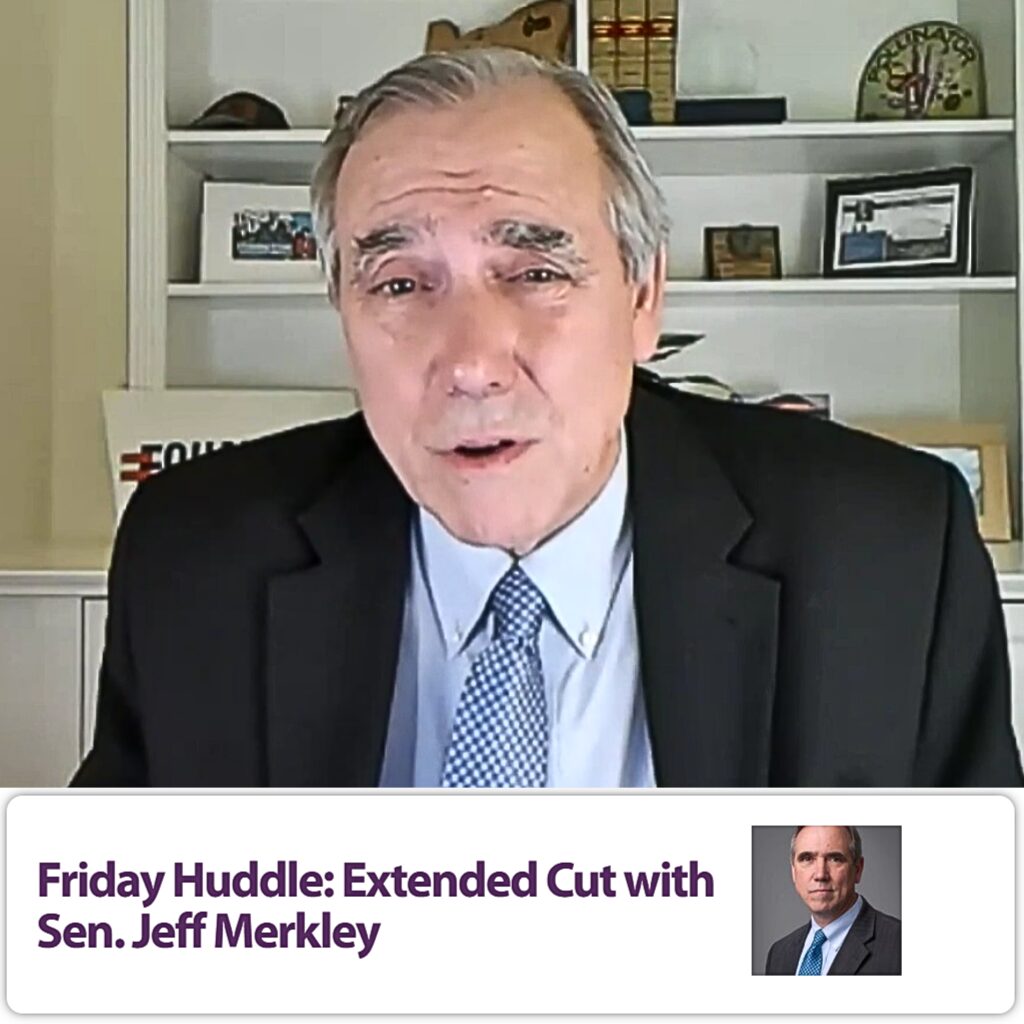
A live conversation with Senator Jeff Merkley focused on national policy developments and implications for Oregon - Nurse well-being
A focused session reviewing survey findings and early insights from pilot projects - Workforce trends
A briefing on the Oregon Healthcare Workforce Index and what emerging data signals for planning
Each session aligned closely with the year’s most prominent themes and provided access to perspectives, data, and analyses that would not have fit within the standard Friday Huddle format.
“It’s one of the few places where we get a real-time sense of what’s happening across the system, not just in our own silos.”
Huddle Participant, 2025
What the Friday Huddle Offers
For many participants, the Friday Huddle is more than a weekly meeting. It is a practice. A way to stay current, learn from peers, and notice early signals before they reach inboxes or headlines.
Huddlers often point to the value of:
- Timely workforce insight across institutions
- Opportunities for leadership, learning, funding, and recognition
- Candid updates on legislation, regulation, and education
- A collaborative space that balances system-level insight with lived experience
Whether you attend every week or join when you can, the Friday Huddle offers something increasingly rare: a consistent, real-time view of Oregon’s nursing workforce in motion. Every form of participation contributes to the shared understanding that makes the space work.
Plan Ahead: The 2026 Friday Huddle Calendar
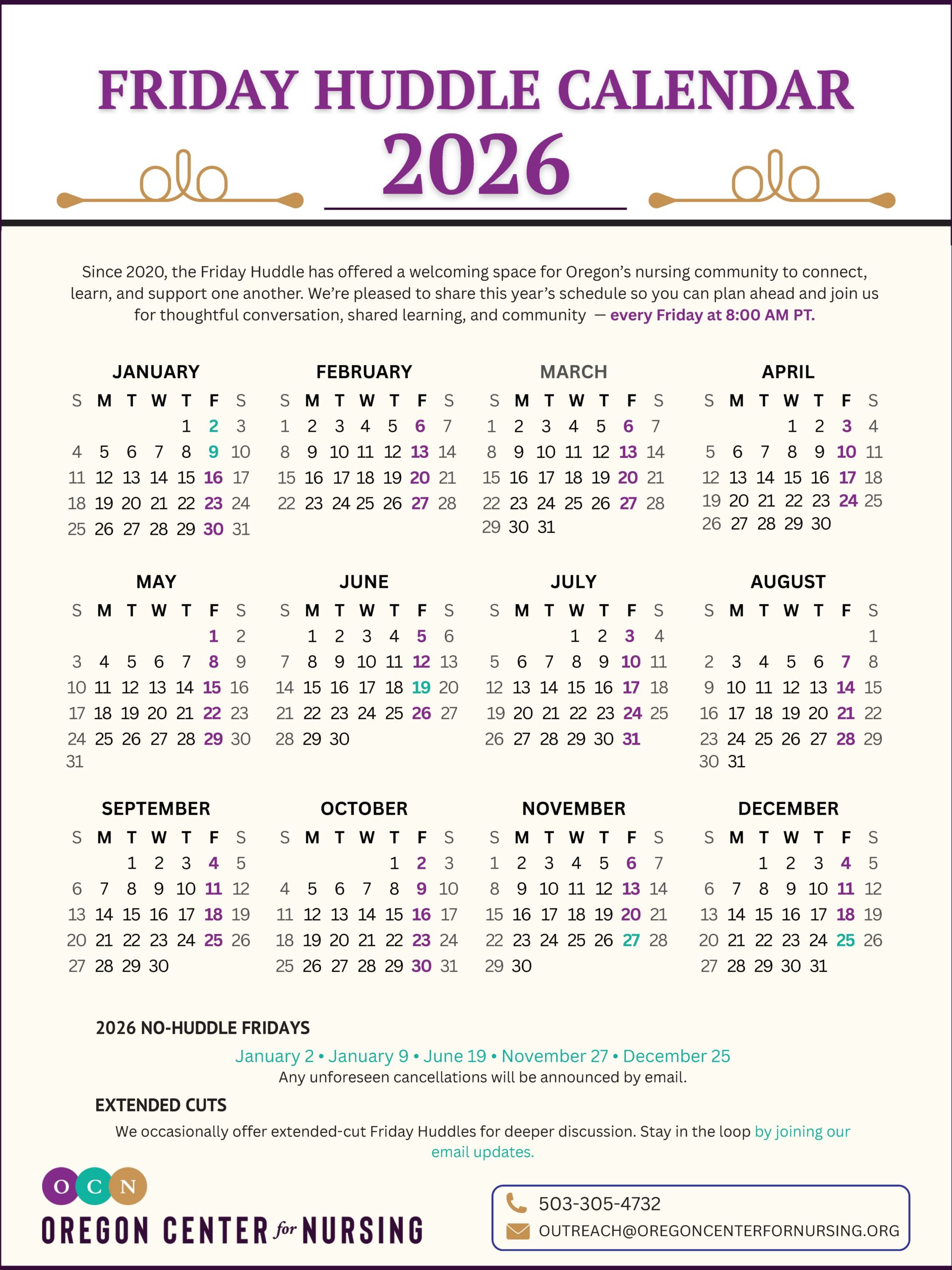
For the first time, OCN has created a Friday Huddle calendar for the year ahead. The 2026 calendar is designed to make it easier to plan around these weekly conversations and integrate them into meetings, initiatives, or team reflection time.
Consider it a small planning tool and a thank-you to the community that continues to make the Friday Huddle relevant and useful.
How to Stay Connected in 2026
We return on January 16, 2026, and we hope you will join us.
The Friday Huddle has always been shaped by the people who show up. Some attend every week. Others join when a topic intersects with their work, their community, or a question they are carrying. However you participate, the space is designed to meet you where you are.
Here are a few ways to stay connected in the year ahead:
- Register to attend the Friday Huddle live
- Sign up for OCN updates by subscribing below if Fridays are not accessible for you
- Download and share weekly summaries to stay informed
- Watch Friday Huddle Extended Cuts when you want to go deeper
- Visit the Friday Huddle page to explore past conversations and resources
Whether you are navigating policy changes, supporting students, adjusting workforce plans, or simply trying to stay connected to what others are seeing across the state, the Friday Huddle is here. It remains open, responsive, and grounded in the realities of Oregon’s nursing workforce.
Together, these shared insights offer a starting point for planning conversations in the year ahead, grounded in what Oregon’s nursing workforce is already experiencing.
If there is a question, challenge, or emerging issue you would like to bring into a future Huddle, let us know. The most meaningful conversations often begin with someone naming what they are noticing. Your voice helps shape what this space becomes, and we look forward to continuing the conversation in 2026.
See you at the Huddle!